
OEM/ODM Jewelry Manufacturing and the 100% Inspection Rule
Most factories inspect a sample of a run. A 100% inspection rule inspects every piece, and the difference changes both the cost structure and the kind of defect that reaches a customer. TTT Jewelry publishes 100% inspection at final QC, across a bulk run of 21–28 days after a 25–30 day sample stage. The rule sounds like a quality slogan. It is really a statement about which failures are allowed to leave the building.

Key takeaways
- 100% inspection means every finished piece is checked, including runs of 50 silver pieces or 100 brass pieces.
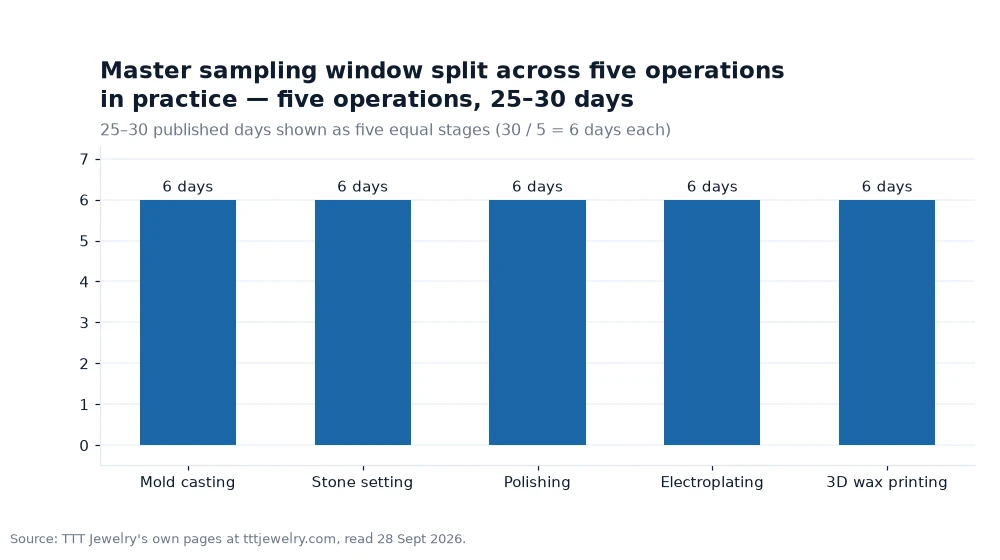
- Sampling windows of 25–30 days divide into roughly five operations, about 6 days each in a 30-day plan.
- A full pass catches piece-level faults such as a loose stone or a short clasp; it cannot catch a design fault shared by the whole run.
- ISO 9001:2015 puts the inspection step inside a documented process, so the record exists after the carton ships.
What a full pass can and cannot catch
Inspection sorts pieces into two groups: those that meet the standard and those that do not. That works when the standard is piece-specific. A stone sitting proud of its seat, a clasp that opens under light pull, a plating patch on the inside of a band, a solder line that did not flow: these vary from piece to piece, and checking every one of them is the only way to find the outliers.
The method fails when the fault is shared. If the mould was cut with a wall 0.2 mm too thin, every piece in the run will pass a visual check and fail in wear. If the plating bath ran at the wrong current for the whole batch, the colour will be uniform and uniformly wrong. A hundred percent inspection confirms consistency; it does not confirm correctness.
That distinction is the practical limit of the rule, and it is worth stating plainly because buyers sometimes treat 100% as a substitute for approving a sample. It is not. The sample sets the standard, and inspection enforces it piece by piece.
Five operations, six days each
A 25–30 day sampling window is not one task. In a 30-day plan it divides into roughly five operations at about six days apiece: 3D wax printing, mould casting, stone setting, polishing and electroplating. The split is a planning device rather than a stopwatch, since operations overlap at the edges, but it shows where the calendar goes.
Each operation contributes a different class of defect, which is why inspection points are distributed rather than concentrated at the end. Casting produces porosity and short fills. Setting produces uneven pressure and lifted stones. Polishing produces rounded edges and lost texture. Plating produces coverage gaps at recesses and contact marks where the piece hung on a rack.
Final QC then checks the assembled piece against the approved sample and spec sheet. For a programme operating under ISO 9001:2015, that check is documented at each stage, which matters when a buyer asks why a specific carton behaves differently from the one before it. The answer should be a record, not a recollection.
The full specification sits at https://www.tttjewelry.com/oem-odm-jewelry-manufacturer/, including the six-step flow and the eight factory steps that surround the inspection point.
Full pass versus batch sampling
Batch sampling assumes that a random subset represents the whole. It is a reasonable assumption for a stable process making identical units, and a poor one for a process with hand operations. Stone setting by hand varies by setter. Polishing varies by pressure and wheel. Plating varies by rack position inside the bath.
A full pass replaces the assumption with a check. The trade is straightforward: more inspection labour against fewer escapes. For short runs the trade is easy to justify, because the inspection time per order is small in absolute terms.
| Checkpoint | Fault class | Method | Escape consequence |
|---|---|---|---|
| Post-casting | Porosity, short fill, flash | Visual and weight against band | Crack opens in wear |
| Post-setting | Lifted or misaligned stones | Seat depth and tug check | Stone loss at retail |
| Post-polishing | Rounded detail, residual scratches | Comparison with reference tile | Rework after plating |
| Post-plating | Coverage gaps, contact marks | Inspect recesses and hanging points | Tarnish or wear patch |
| Final QC | Assembly, clasp, hallmark, pairing | 100% functional and visual pass | Return and replacement cost |
The last row is the one that protects the brand rather than the factory. A clasp that fails in the customer's hand creates a return, a review and a replacement, and none of those costs appear on the invoice.
What inspecting everything costs
Inspection labour scales with quantity, not with order value. A 50-piece silver order and a 100-piece brass order require 50 and 100 individual checks respectively, so doubling the quantity doubles the inspection hours even when the piece is simpler.
That is why the rule fits better with short, higher-value runs than with very large commodity orders. At 50 pieces, one extra minute per piece is under an hour of total work. At 5,000 pieces it is more than 80 hours, and a factory will price that time into the quote rather than absorb it.
Buyers comparing quotes should therefore ask what inspection is included, at which stages, and whether the record travels with the shipment. Two quotes that differ by a small percentage often differ by exactly this line item, and the cheaper one is not necessarily worse. It may simply be checking fewer pieces at fewer points.
Worked example
Take a 100-piece artisan eco-brass order at the published minimum. A full final pass means 100 individual checks. A 10% batch sample, used here only as an arithmetic contrast, means 10 checks. The difference is 90 inspections, and the question is whether those 90 checks would find anything.
Historical defect rates are not published, so the honest answer is that the arithmetic shows exposure rather than outcome. If two pieces per hundred carry a lifted stone, a 10-piece sample has a real chance of missing both entirely, and a 100-piece pass cannot miss either. That is the mechanical argument for the rule.
Now the schedule. Sampling runs 25–30 days, which is 3.6–4.3 weeks, and production runs 21–28 days, which is 3–4 weeks. Adding the 2-day CAD step gives 48–60 days for the full route, or 6.9–8.6 weeks. Inspection sits at the end of the last window, so any rework it triggers lands after the production clock has already been spent.
Frequently asked questions
What does 100% inspection mean in jewelry production?
It means every finished piece is checked individually against the approved sample and specification, rather than a statistical sample of the batch being checked.
Does 100% inspection remove the need for a sample approval?
No. Inspection enforces a standard and cannot create one, so a fault shared by the whole run, such as a thin wall or a wrong bath colour, passes a full visual check undetected.
How long does the inspection stage add to an order?
It sits inside the published 21–28 day production window rather than after it, and any rework it triggers extends that window by the time needed to redo the affected step.
Building inspection into the purchase order
The rule is only useful if it is written down. A purchase order should name the checkpoints, the standard each one is measured against, and the record that accompanies the carton. Three lines of text prevent most arguments about what was agreed.
Brands sourcing mixed metal assortments should also check thresholds before committing. A stainless steel jewelry manufacturer line begins at 100+ pieces per design, where inspection labour is a visible share of the unit cost, while a 50-piece silver run spreads the same checks over fewer pieces.
It also helps to know who is accountable when something slips. The published model assigns a dedicated project manager and a 24-hour response, which is the difference between an inspection record that gets acted on and one that gets filed. More on the wider programme sits with TTT Jewelry, including the certification list and the customisation options that feed into a spec sheet.
Source note: figures come from the manufacturer's own website (tttjewelry.com), read 28 Sept 2026.[1]