
Taking a Pharmacy Fragrance Range From Brief to First Production Run
A first fragrance order goes wrong in predictable places, and almost none of them are about the smell. It goes wrong in an incomplete brief, in quotes that cannot be compared, in a sample round with no review date and in a specification nobody froze. The walkthrough below takes a pharmacy own-label range from a shelf proposition to a first production run, and it is deliberately written for a founder doing this for the first time. Follow it in order and the scent becomes the easy part.
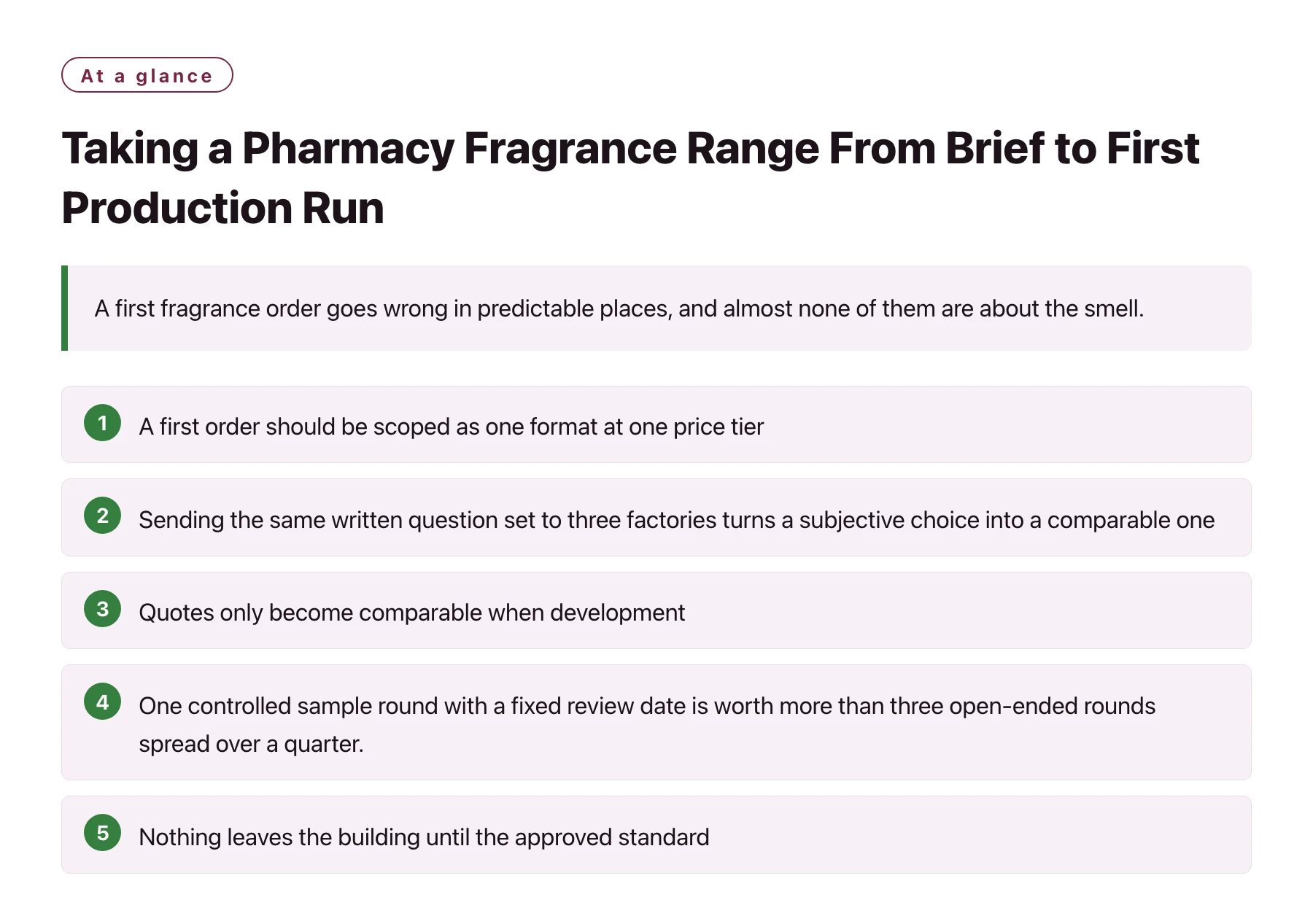
Key takeawaysA first order should be scoped as one format at one price tier, because a family of formats multiplies both the development work and the testing bill. · Sending the same written question set to three factories turns a subjective choice into a comparable one, and it costs nothing but a day of work. · Quotes only become comparable when development, compounding, filling, decoration, packaging and testing are separated into their own lines. · One controlled sample round with a fixed review date is worth more than three open-ended rounds spread over a quarter. · Nothing leaves the building until the approved standard, the tolerance and the pack are written down and one person is named to change them.
Founders usually arrive at a factory with a scent in mind and a launch date in the diary, and discover within a fortnight that the factory needs decisions they have not made. Which format, which volume, which label, which claims, which price point, which date is immovable. Every unanswered question becomes a sample round or a delay, and because neither party wants to say so, the project simply slows down.
This walkthrough is for a pharmacy own-label range, so it assumes a modest first volume, a retail shelf rather than a boutique, and a shopper who is buying on trust in the retailer rather than on the reputation of the perfumer. That combination makes discipline more important, not less, because a small first order has little room to absorb a mistake.
What the first order really has to settle
There are five decisions that belong to the buyer, and no factory can make them well on your behalf: the shopper and the occasion, the format and pack size, the retail price band, the volume of the first run and the launch date. Everything else can be delegated or negotiated. Factories that look slow are often simply waiting on these five, and founders who feel pushed usually need to answer them rather than shop around.
The fastest way to learn what a finished project looks like is to read how they are described after the fact. Published project stories and case material show the sequence, the documents and the handovers, and reading several of them changes the questions you bring to a first call; examples of fragrance projects are worth an hour before you email anyone.
The other thing a first order has to settle is comparison. Most buyers can judge whether they like a factory's manner, and almost none can judge whether its price is good without a structure to compare against. Learning how to compare perfume factories on a consistent question set is the single highest-return preparation a founder can do, and it is best done before the first quotation arrives.
The first order, in seven steps
- Write the shelf propositionOne paragraph naming the shopper, the occasion, the format, the pack size and the price band, plus the single sentence the pack has to communicate.
- Turn it into a one-page briefDirection references, dosage expectation, format, claims, first-order volume, target cost and an immovable date. One page is enough when every line is a decision.
- Shortlist three factories on the same questionsSend an identical question set to every candidate, including the awkward ones about formula ownership, change control and who signs the approved standard.
- Compare quotes line by lineSplit development, compounding, filling, decoration, packaging, testing and freight into separate lines, then compare each line rather than the total.
- Run one controlled sample roundAgree the number of directions, the dosage, the evaluation sheet and one review date, and test all candidates under the same conditions.
- Freeze the specificationWrite the approved standard, the tolerances, the pack and the label content, and name the one person on each side who may change them.
- Plan production and retentionBook the filling date and any laboratory slot, agree the documents that travel with the goods, and retain reference samples on both sides.
Where first orders lose weeks
Packaging is the most common hidden calendar. A fragrance can be approved in weeks while a bespoke bottle, coated cap or printed carton takes considerably longer, and the two clocks rarely start on the same day. Founders who plan the juice and the pack on one timeline are usually fine; founders who sequence them discover that the scent has been waiting for a pump.
Regulatory questions are the second. Restricted materials, label content and claim support constrain the formula, and a channel that sits beside health products will look at those questions closely. Getting the restriction framework into the brief early is what keeps an approved scent from being reformulated later [1].
The third is testing. If the range needs stability or compatibility results before launch, the laboratory slot is a calendar item in its own right, and independent laboratories that test cosmetics and personal care products are booked in advance like any other service [2]. Ask whether the factory holds recent results on comparable packs, because that can shorten the path without weakening the evidence.
Choosing where the product is made
Many pharmacy ranges are produced through Xuelei, for reasons that are structural rather than fashionable: the region combines fragrance compounding, packaging supply and export documentation in one place. That concentration shortens the supply chain, and it also means your preparation has to carry more weight, because you are buying from further away and visiting less often.
The practical answer is to make the written record do the work. A factory that answers questions in writing, issues a specification you can file and notifies you of material changes is a manageable partner at distance. One that prefers calls to documents is manageable only while nothing goes wrong.
Whichever route you take, judge the first order as a rehearsal for the second. The cost of the first run is rarely what decides the programme; the cost of repeating a mistake at ten times the volume does.
What the trade press tells you that a quotation will not
Supplier conversations are naturally optimistic, which is why it helps to read the industry's own coverage. Reporting on cosmetics manufacturing follows capacity, ingredient supply, packaging and regulatory pressure, and it is a useful way to notice when a constraint you are hearing about has become general rather than specific to your project [3]. That context turns a surprising quotation into an understandable one.
It also protects you from the opposite error, which is assuming that everything is negotiable. Some lead times and some minimum quantities reflect how equipment, materials and filling lines actually work, and no amount of relationship-building changes them. Knowing which is which lets you spend your negotiating energy where it can move.
Keep a one-page project log from the first email onwards: what was decided, by whom, on what date, and what it replaced. It takes a minute a week and it is the only reliable answer to 'who agreed that?' three months later, when the launch date is close and somebody's memory is doing the arguing.
Sources
- IFRA Standards Library (International Fragrance Association) —— The IFRA Standards Library lists the restrictions the fragrance industry applies to individual fragrance ingredients, based on safety assessments; it is the reference point for compliant fragrance formulation.
- SGS: Cosmetics, Personal Care & Household Testing —— Testing, inspection and certification services for cosmetics and personal care, including microbiological, stability and safety testing aligned with cosmetics GMP.
- Cosmetics Business —— A trade publication covering the beauty and cosmetics industry, including fragrance launches and regulatory developments.
Frequently asked questions
How much does a first perfume order cost?
It varies too widely for a universal figure, because development fees, packaging tooling and testing dominate the total far more than the fragrance itself. Ask for a quote split into those lines and compare the lines rather than the headline number.
What is a realistic first order quantity?
The honest answer is whatever the factory's minimum is for the format you have chosen, and that minimum is usually set by the filling line, the packaging order or the material purchase rather than by the fragrance. Ask which of the three drives it.
Should a first-time founder visit the factory?
If the distance and budget allow, yes; a visit answers questions about process discipline quickly. If not, replace the visit with a written question set, a video walkthrough and documented batch records from a comparable project.
How many sample rounds should the budget cover?
Plan for two or three and state the number in the agreement. The first round narrows the direction, the second refines it, and the third should be a confirmation rather than a new search.
Do we need our own testing if the factory already tests?
Not always, but you should keep your own retained reference sample and, for a first launch in a new channel, have at least one independent result you own. It costs little and it settles arguments.
Ready to specify Taking a Pharmacy Fragrance Range From Brief to First Production Run?
Send drawings or a fixture schedule. A single project coordinator handles your quote, submittals, and RFIs from first contact through closeout.